World's largest financial institutions rely on our models for critical decisions.
Trusted, and verified!

The platform has solved two structural problems that lead to poor decisions

Explainability

Most existing frameworks optimize single objectives during construction, but evaluate results across multiple dimensions. This disconnect makes it difficult to understand and explain model behavior in production.

Stability

Classical models degrade as new market data accumulates because they are anchored to historical states. They struggle to adapt to structural changes, regime shifts, and expanding time series complexity.

Our trademarked and patent-pending Explainability Index (EI) and Robust Rolling (R2) processes drive stable and explainable decisions, including machine-driven decisions across Agents, LLMs, and more. Additionally, reinforcement learning and optionality can be understood and managed more granularly through Risk of Target (RoT).


Data Management

Models that ensure stable results as time-series data increases

The Robust Rolling (R2) temporally stable data processing models are designed for processing accuracy over any period.

Linear Reduction

R2-PCA extends PCA to time series datasets by relating sequences of eigen-decompositions with the cosine similarity measure (dot product). R2-PCA fixes the eigenvector sign-flipping issue and can operate on datasets in higher dimensions or variable feature spaces.

Non-linear Reduction

R2-UMAP extends tSNE and UMAP to time series data. These algorithms provide stable representations of low dimensional data, even when it changes over time.

Regimes

R2-RD robustly identifies the financial regimes and their defining characteristics. It can utilize the streaming financial data to picture the regimes' evolution and transition probabilities dynamically. Extensions for R2-GHMM, R2-GH1HMM, R2-AR HMM, etc.

Clusters

R2-K-Means extends K-Means to cluster securities in time series. R2K-Means allows the groupings to be updated over time when new financial data becomes available. Additionally, R2K-Means uses a rolling window of centroids to produce nonlinear decision boundaries. Extensions for R2-Spectral, R2-DBSCAN, etc.

Factors

R2-Factors is a cluster-based autoencoder–type neural network that aggregates rich data regarding security performance, security characteristics to identify either cluster-specific or generic factors.

Sythentic

TAGAN and TTGAN utilize attention mechanisms to generate synthetic data with same stylized facts of real data.

Signals

Predicts prices, sector importance, arbitrage success etc.


Asset and Wealth Management

Explainable frameworks provide greater control over investment management processes

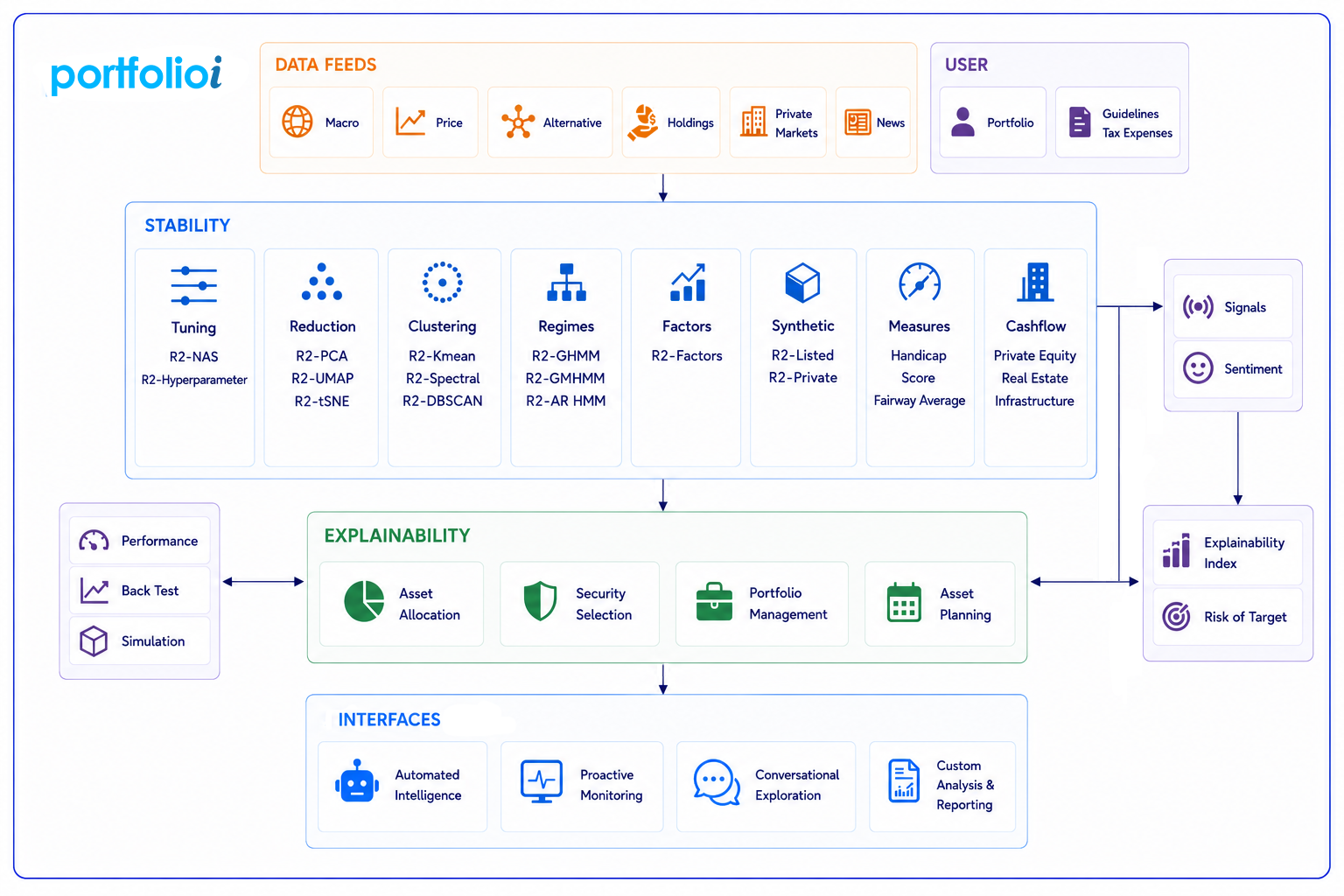
The platform unifies data ingestion, infrastructure, tested AI models, and trusted data sources into a scalable system that evolves with model advancements and real-time workflows. Delivering a 360° view of decisions with integrated Performance, Simulation, and Backtesting, enabling optimized decision support across the data lake.

The Portfolio-i Platform

AI-powered data processing, analysis, and decision support platform.

Explainable Asset Allocation™

Concurrently targets multiple performance measures during construction, better aligning with downstream assessment and explainability. This detailed, multi-dimensional construction allows for more granular mapping of client profiles.

Explainable Security Selection™

Incorporates multiple performance measures within ranking algorithms (pairwise, pointwise, etc), better aligning with downstream assessment and explainability.

Explainable Portfolio Management™

Concurrently incorporates multiple performance measures during construction, better aligning with downstream assessment and explainability. It also incorporates user utility, constraints and tax considerations. The framework has portfolio construction, optimization, transition and replication abilities.

Asset Planning

Combines listed and unlisted predicted cashflows. Combined profiles can be stressed given macro events, regimes or scenarios.


Credit Management

Proprietary framework from data exploration to decisioning models

Every aspect of the credit modeling pipeline—including feature engineering, segmentation, model selection, and evaluation—has been deconstructed, assessed, and refined with Machine Learning and Deep Learning models for credit assessment, limit setting, and profit targeting.

01

Credit Score

Proprietary AI models that analyze behavioral patterns and relationships to more accurately predict default risk for consumer and commercial loans.

Includes adaptive monitoring metrics that detect shifts in portfolio behavior and changing market conditions.

02

Credit Limit

Proprietary AI models that combine predictive modeling, portfolio optimization, and adaptive credit management to improve approval quality, maximize returns, and reduce risk exposure.

03

Explainability

Unified explainability framework designed to improve model transparency, governance, and interpretability.

The proprietary Explainability Index (EI) standardizes diverse model metrics into comparable scores, enabling aggregated risk and performance analysis across models and portfolios.

04

Fraud Detection

Proprietary fraud and risk detection framework that combines behavioral sequencing, relationship intelligence, and financial analysis to identify fraudulent and non-creditworthy applications.

Supports additional financial features, including expense and cash flow data, for deeper underwriting accuracy.


Unstructured Data Management

Transform unstructured raw data into auditable action items

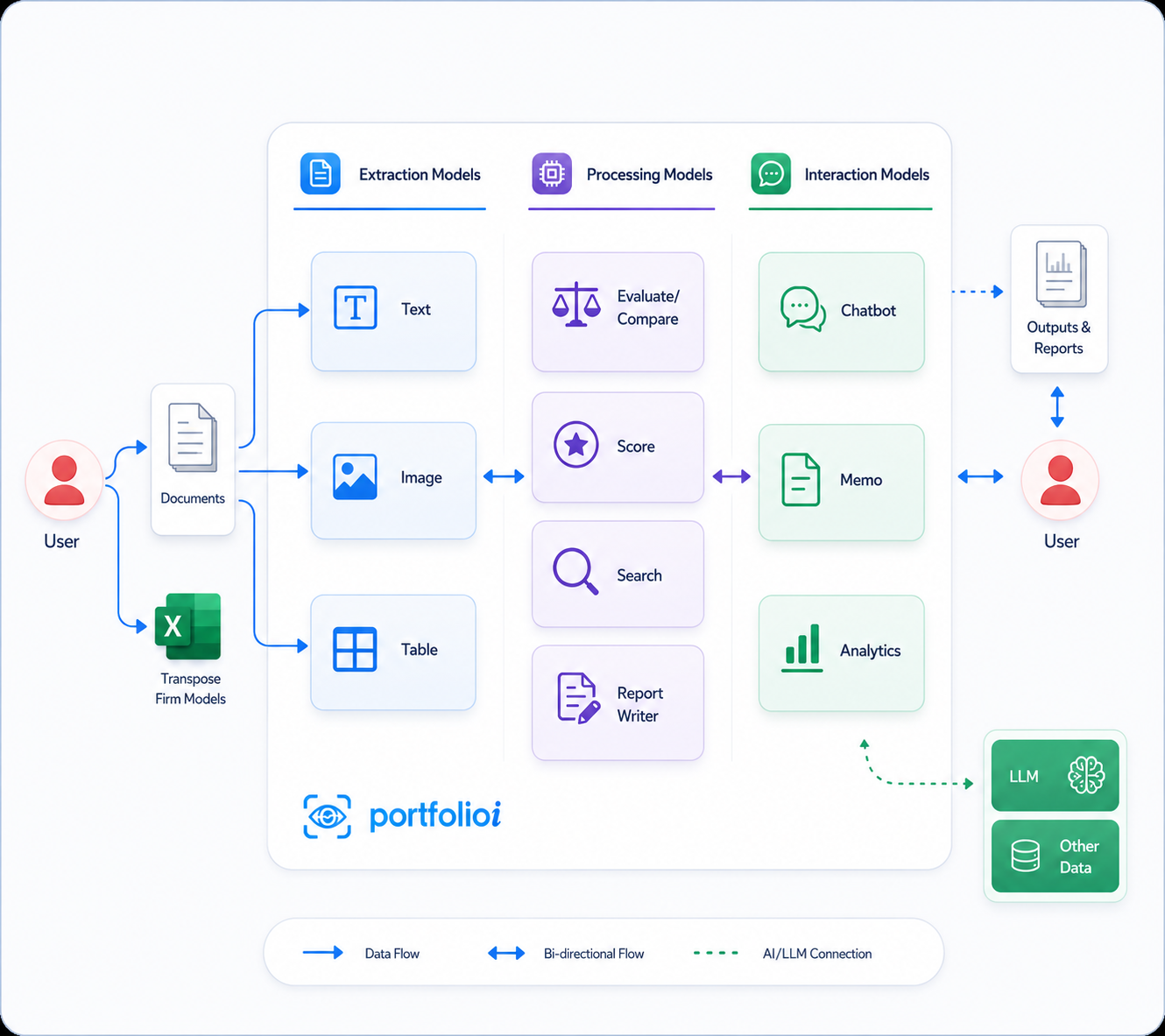
From raw data to actionable information, tools built for institutional workflows. Extract, analyze, test and act with confidence -- no black boxes.

All results are transparent, auditable, and designed for teams that need to see the evidence behind every decision.

Setup

Flexible RAG pipeline and architecture that allows data processing and user control for balancing cost, speed and accuracy.

Extraction

Choice of tuned, proprietary models for processing unstructured data into text, table and image information blocks. Ability to audit and edit information blocks for downstream tasks. Conduct relationship analysis through knowledge graphs before queries or generating reports.

LLM & Prompt Engineering

External sources and internal information blocks with archived audit trails. Setup multiple configurations with choice for global firm, user-based and/or for querying specific deployment. Incorporate memory, feedback and guardrails. Tune as many LLMs in parallel by assessing responses or suggested questions based on answers.

Applications

Generate reports from user-specified templates or fully customized outputs for one-off or batch processes. Support documented human-in-the-loop review and approval workflows prior to final analysis or report generation. Validate extraction, retrieval, and editing workflows to improve accuracy and reduce hallucinations. Seamlessly supports archives, books and records management.


See howPortfolio-isupports decisions.